

With the launch of the new Idromeccanica Lucchini website, we want to inaugurate a series of informative articles designed to assist farmers, technicians, and enthusiasts in advanced greenhouse management. Alongside our usual case histories, you will also find articles like this one, which explain in a simple yet precise manner how to tackle daily challenges in the greenhouse, in light of new industry trends.
Let’s start with a classic of Italian agriculture: the tomato. The king of vegetables requires attention, knowledge, and a professional approach, especially in soilless cultivation. But how can you achieve a healthy, profitable, and sustainable production? Let’s find out together.
Greenhouse for Tomatoes: why how You Grow Them Matters
Tomato is among the most widespread crops in the world and one of the most appreciated vegetables on Italian tables. However, growing it well is not simple, especially in greenhouses and soilless. Success depends on a mix of climatic, varietal, nutritional, and management factors.
A common mistake? Focusing only on what to grow, and not on how. The cultivation technique and control of environmental conditions are often more important than the chosen variety.


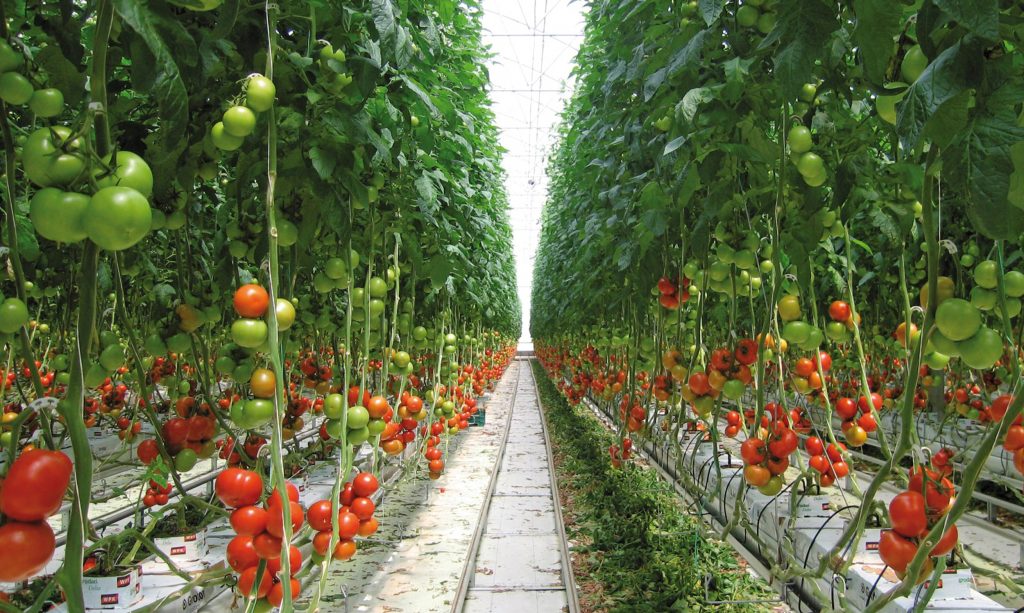


1. Climate and environmental control: stability above all
Tomato prefers a mild and stable climate, ideally between 18°C and 25°C. But that’s not enough: controlled humidity, constant air exchange, and particular attention in the early hours of the day are needed. Why? At sunrise, the plant “wakes up,” opens its stomata, and activates. In this critical moment, the dew present can be a vehicle for pathogens, creating the perfect habitat for molds, fungi, and bacteria.
Technical advice: artificially heat the tomato greenhouse in the early morning hours to remove residual humidity and prevent infections.
2. Monitoring and prevention: the true competitive advantage
In a modern greenhouse, a reactive approach is not enough. Predictive monitoring is needed: visual, sensor-based, and/or based on climatic and agronomic data. This allows you to:
- Intervene in a targeted manner
- Prevent the spread of pathogens
- Optimize treatments
- Avoid resistances due to repeated and ineffective treatments
Mistake to avoid: not analyzing data or acting “on instinct.” Professional agriculture today is also and above all about intelligent information management.
3. Variety, nutrition, and irrigation: three levers for productivity
Choosing the right variety is a fundamental first step. Varieties
- Too much nitrogen stimulates excessive vegetation and hinders fruiting
- Good nutrition strengthens thermoregulation, essential in summer
Technical advice: constant but well-calibrated irrigation; overuse or scarcity can compromise fruit quality and plant health.
4. Substrate and roots: attention to what is not seen
In soilless cultivation, substrate and soil are true “habitats” for the root. They must be monitored and replaced periodically. Roots are the first point of impact for pathologies and nutritional imbalances. A diseased root can compromise the entire plant organism.

5. Maintenance and cleaning: the greenhouse is an agricultural machine
A neglected greenhouse is an inefficient greenhouse. Periodic cleaning, both of surfaces and technical structures, is a fundamental investment for:
- Crop health
- Climatic efficiency
- Durability of installations
Remember: leaves should not be excessively pruned. They protect from heat and help the plant “breathe.” Fewer leaves, more stress.
Conclusion – Good Cultivation is Possible: and Necessary
In a greenhouse, every technical choice has a direct impact on yield, plant health, and production costs. Working methodically, following data and good agronomic sense means respecting the plant, increasing productivity, and ensuring consistent quality.
Idromeccanica Lucchini supports producers with tailored solutions for every need: technological greenhouses, climate control systems, irrigation systems, and agronomic consultancy.
This is just the first in a series of technical insights. Because explaining how this fascinating world works is part of our DNA.
We look forward to seeing you in the next article on our blog!


